
Last Updated: October 28, 2026
Quick Summary
To calculate peptide salt content, divide the free peptide mass by the total salt mass and multiply by 100, where salt mass equals free peptide mass plus counterion mass. Counterion equivalents per peptide equal the number of protonatable basic sites, adjusted for the salt form on the certificate of analysis. Treat the COA's net content figure as the primary source and the stoichiometric calculation as a cross-check.
- Peptide content is the share of a vial's total mass that is actual peptide, while purity is the share of detected material matching your target sequence.
- A peptide with four basic sites as the acetate salt carries roughly 4 x 59.04 = 236.16 g/mol of counterion mass on top of the free base.
- The same peptide as a TFA salt versus an acetate salt differs by roughly 11 percentage points in actual peptide.
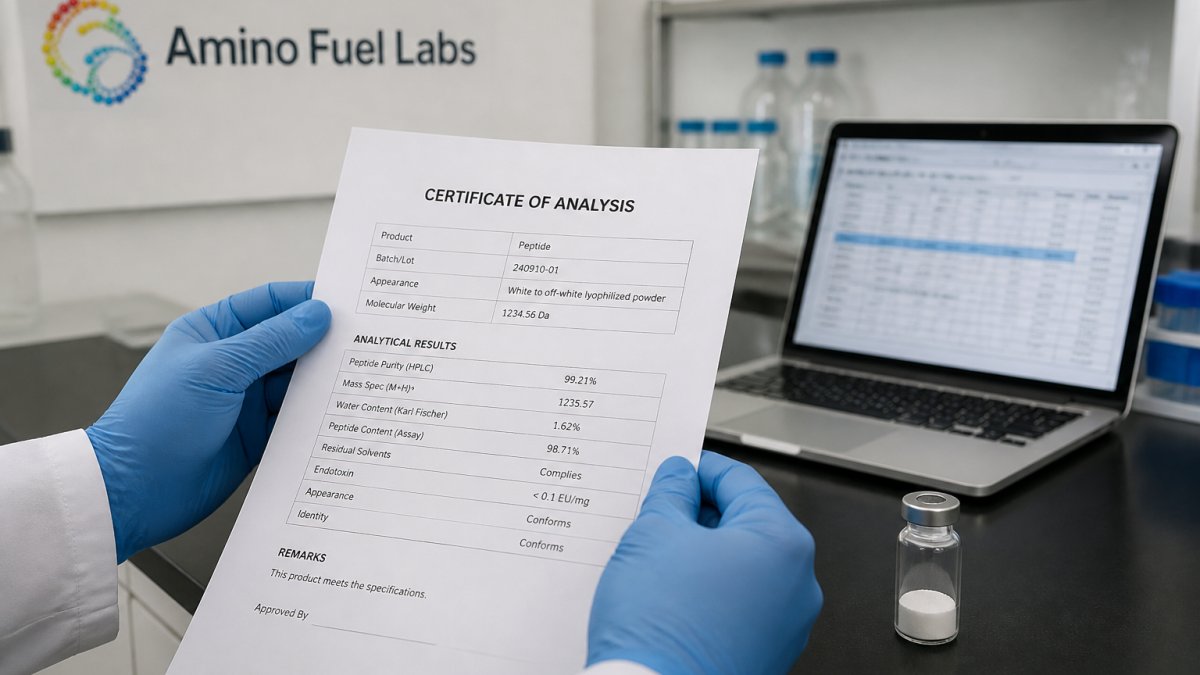
- Read the COA in this order: identity, purity, net peptide content or assay, salt form, then lot number and test date.
- Carry extra digits through intermediate steps and round only at the end to avoid stacking error.
Table of Contents
- Peptide Salt Content Calculation Guide: What the Numbers on the Vial Actually Mean
- Peptide Content Versus Purity: The Difference That Changes Your Dose
- Peptide Molecular Weight with Counterions: Why the Label Mass Is Not All Peptide
- Peptide Content Calculation Example: From COA to Corrected Mass
- Peptide Certificate of Analysis Interpretation: Reading the Numbers That Matter
- Step-by-Step Reconstitution and Draw Volume After Salt Correction
- Rounding, Uncertainty, and Measurement Limits in Peptide Calculations
- Verify Your Next Lot with Amino Fuel Labs Documentation
- Frequently Asked Questions
Peptide Salt Content Calculation Guide: What the Numbers on the Vial Actually Mean
A peptide salt content calculation guide matters because the mass printed on a vial is rarely pure peptide. Most research peptides ship as salts, and the counterions bound to them add weight that does nothing for your experiment.
Purity tells you how much of the detected material is your target peptide; net peptide content tells you how much of the vial mass is peptide at all. Only the latter belongs in your concentration math.
Peptide Content Versus Purity: The Difference That Changes Your Dose
Peptide content is the share of a vial's total mass that is actual peptide, while purity is the share of detected material that matches your target sequence. A vial can be 98% pure and still be only 80% peptide by mass.
That gap comes from water, counterions, and residual solvents. Lyophilized powder holds moisture. Salt forms carry counterions. Neither shows up as an impurity on a purity chromatogram, but both add weight on the balance.
So the numbers diverge:
- Purity answers: is this the right molecule, and how clean?
- Net peptide content answers: how much peptide is in this milligram?
For a deeper walkthrough of how water and counterions change vial mass, read peptide purity versus net peptide content, which includes an illustrative calculation. Our explainer on understanding peptide purity vs net peptide content covers the two figures side by side.
Peptide Molecular Weight with Counterions: Why the Label Mass Is Not All Peptide
Every peptide salt carries a counterion, and each counterion adds molecular weight. Acetate and trifluoroacetate are most common in research peptides, but chloride, citrate, and occasionally sulfate appear too. The free base mass is what your molar math needs; the salt mass is what sits in the vial. The bridge between them is stoichiometry, not a catalog-wide percentage.
The counterion arithmetic, step by step
The correction rests on charge balance. Each basic residue, lysine, arginine, and the N-terminal amine, can carry one positive charge at neutral pH, and histidine can contribute a partial charge depending on pH. Each positive charge pairs with one counterion equivalent, so moles of counterion per mole of peptide equal the number of protonatable basic sites, adjusted for the salt form on the certificate of analysis.
- Free peptide mass (mg) = moles of peptide × free base molecular weight (g/mol) × 1,000
- Counterion mass (mg) = moles of peptide × (counterion equivalents per peptide) × counterion molecular weight (g/mol) × 1,000
- Salt mass (mg) = free peptide mass + counterion mass
- Net peptide content (%) = free peptide mass ÷ salt mass × 100
Common counterion formula weights: acetate (C₂H₃O₂⁻) ≈ 59.04 g/mol; trifluoroacetate (CF₃COO⁻) ≈ 113.02 g/mol; chloride (Cl⁻) ≈ 35.45 g/mol. A peptide with four basic sites as the acetate salt carries roughly 4 × 59.04 = 236.16 g/mol of counterion mass on top of the free base.
A transparent worked example
Assume a hypothetical decapeptide with a free base molecular weight of 1,200 g/mol and four basic residues, supplied as the acetate salt. One mole of peptide binds four moles of acetate.
- Free base mass per mole: 1,200 g
- Counterion mass per mole: 4 × 59.04 = 236.16 g
- Salt mass per mole: 1,436.16 g
- Net peptide content: 1,200 ÷ 1,436.16 ≈ 83.6%
As the trifluoroacetate salt, counterion mass per mole would be 4 × 113.02 = 452.08 g, salt mass 1,652.08 g, and net peptide content ≈ 72.6%. Same peptide, same label mass, roughly 11 percentage points difference in actual peptide, purely from the salt form. That is why a universal correction factor is inappropriate without product-specific documentation.
Where the label mass goes wrong
A 5 mg label on an acetate salt at 83.6% net content means about 4.18 mg of actual peptide; the same label on a TFA salt at 72.6% means about 3.63 mg. Neither vial is mislabeled, the label refers to total salt mass, which is the convention. The error enters when label mass is dropped straight into concentration math without correction.
Mass spectrometry confirms identity and intact mass, but it does not erase the counterion question: an intact mass consistent with the salt form tells you the stoichiometry is plausible, not that the COA's net content figure is correct. For the measurement side, mass spectrometry for peptide identity confirmation explains ionization, charge states, and deconvolution. The COA's assay and water content lines turn the stoichiometric estimate into a measured value.
The counterion arithmetic depends on which salt form the peptide ships as, and the formula weights below drive every correction.
| Counterion | Formula weight (g/mol) | Note |
|---|---|---|
| Acetate (C₂H₃O₂⁻) | ≈ 59.04 | Common in research peptides |
| Trifluoroacetate (CF₃COO⁻) | ≈ 113.02 | Common in research peptides |
| Chloride (Cl⁻) | ≈ 35.45 | Appears in research peptides |
| Citrate | Not stated | Appears in research peptides |
| Sulfate | Not stated | Occasionally appears |
Peptide Content Calculation Example: From COA to Corrected Mass
Most guides stop at "multiply the label mass by net content." That is the right first step, but it hides three things: whether the COA reports net content on an as-is or anhydrous basis, how water content is handled, and how much precision the answer can honestly carry. Two examples follow, with units at every step.
Example 1: Acetate salt with a reported net content
Assumptions stated up front:
Compare that to the uncorrected path: 5 mg ÷ 2.5 mL = 2.0 mg/mL, and 0.250 mg ÷ 2.0 mg/mL = 0.125 mL = 12.5 units. The corrected draw is about 20% larger because the label mass overstated peptide by 16%; drawing 12.5 units would have delivered roughly 0.210 mg instead of 0.250 mg.
Example 2: TFA salt with a wider correction
Assumptions stated up front:
The uncorrected path would give 2.0 mg/mL and a 0.050 mL (5 unit) draw, a 27% underdraw relative to the corrected value. The wider the salt correction, the larger the error from skipping it.
Carrying uncertainty through the chain
A practical propagation rule: convert each input to a relative uncertainty, add them in quadrature, and report the result to the precision the largest contributor supports. For the first example, 2% (mass), roughly 0.06% (content, from 0.05 ÷ 84), and 1% (volume) combine to about 2.2% relative uncertainty on the final concentration, supporting 1.68 mg/mL, not 1.684 mg/mL.
The order of operations that prevents errors
For the measurement framework behind these tolerances, the NIST reference on measurement uncertainty is the standard starting point. For how COA figures are generated and documented, the FDA's guidance on analytical procedures covers validation expectations.
Peptide Certificate of Analysis Interpretation: Reading the Numbers That Matter
A certificate of analysis is only useful if you read the right line. Most researchers scan straight to the purity figure and stop. That is a mistake.
Read the COA in this order:
- Identity - sequence and molecular weight confirmation
- Purity - HPLC percentage of target peak
- Net peptide content or assay - the mass correction figure
- Salt form - acetate, TFA, or other
- Lot number and test date - matches your vial?
Watch out: a high purity number does not guarantee high peptide content. For the full procedure, see how to verify peptide purity. Researchers who assume the two track each other often wonder why in vitro results shift between lots.
Step-by-Step Reconstitution and Draw Volume After Salt Correction
Expected result: a clear solution with a concentration you can defend on paper.
Watch out: mixing before the powder fully dissolves gives you an uneven concentration. Measure only after the solution is clear.
Rounding, Uncertainty, and Measurement Limits in Peptide Calculations
Every number in this chain carries uncertainty. The COA figure has a tolerance. Your balance has a readability limit. Your syringe has graduations. Rounding at each step stacks error.
Practical rules we follow:
- Carry extra digits through intermediate steps, round only at the end
- Match your reported precision to your least precise measurement
- Never report a concentration to four decimals when your balance reads to 0.1 mg
- Note the COA's stated tolerance next to your calculation
Verify Your Next Lot with Amino Fuel Labs Documentation
At Amino Fuel Labs, every product ships with a lot-matched third-party Certificate of Analysis and accessible HPLC and MS lab reports.
Before you accept any lot, check these requirements:
- <input disabled type="checkbox"> COA lot number matches the vial label
- <input disabled type="checkbox"> Third-party lab named and independent
- <input disabled type="checkbox"> Purity and net content both reported
- <input disabled type="checkbox"> Salt form stated
- <input disabled type="checkbox"> Test date within your acceptance window
- <input disabled type="checkbox"> Raw chromatograms available on request
Frequently Asked Questions
How do you calculate peptide salt content?
Peptide salt content is calculated from the Certificate of Analysis by subtracting net peptide content from the total weighed mass. If a vial contains 5 mg of material and the COA reports 80% net peptide content, the actual peptide is 4 mg and the remaining 1 mg is counterions, moisture, and residual solvents. Always use the lot-specific COA figure rather than assuming 100% peptide.
How do counterions affect the calculated mass of a peptide?
Counterions such as acetate or trifluoroacetate add molecular weight to the peptide salt without adding active peptide. For example, a peptide with a molecular weight of 1,000 Da and two acetate counterions gains roughly 120 Da, so the salt mass is about 12% higher than the peptide mass alone. When you calculate peptide molecular weight with counterions, you must correct for this difference to avoid overstating the amount of peptide in a vial.
What is the difference between peptide purity and peptide content?
Purity measures the percentage of the target peptide relative to other detected material, as reported by HPLC. Peptide content versus purity is a critical distinction.
How should a Certificate of Analysis report peptide content?
A Certificate of Analysis from Amino Fuel Labs is lot-matched to the product and reports HPLC purity and mass-spectrometry identity.
Getting salt content right is not glamorous work, but it is the difference between a reproducible study and one you cannot defend. Amino Fuel Labs supports that work with 99%+ HPLC purity, lot-matched third-party Certificates of Analysis, and 24/7 support when a number on a report needs explaining. Get started with Amino Fuel Labs and calculate your next protocol from verified documentation, not from a label.
