
Table of Contents
- Why Peptide Purity Verification Matters
- What Purity Percentage Does and Does Not Measure
- HPLC Peptide Purity Analysis: How the Method Works
- Peptide Mass Spectrometry Testing for Identity Confirmation
- How to Read a Peptide Certificate of Analysis
- Step 1: Match the lot number and sample identity
- Step 2: Verify the test methods are named and appropriate
- Step 3: Confirm the testing laboratory and its independence
- Step 4: Check the test date and lot coverage
- Step 5: Review the raw data, not just the summary
- Step 6: Cross-check the molecular weight and purity calculation
- Third-Party Peptide Testing Labs: How to Evaluate Competence
- Sample Handling, Chain of Custody, and Suspicious Results
- Conclusion
- Frequently Asked Questions
Last Updated: October 18, 2026
Why Peptide Purity Verification Matters
Learning how to verify peptide purity starts with one uncomfortable fact: a purity percentage on a label tells you less than you think.
At Amino Fuel Labs, we treat documentation as part of the product, not a marketing extra.
Why does this matter so much? A research peptide is only as useful as it is defined. If a vial contains degraded material, residual solvents, or the wrong sequence entirely, your results reflect the contaminant, not the compound.
What Purity Percentage Does and Does Not Measure
Peptide purity is the share of a sample that appears as the main peak in a chromatographic separation, usually expressed as an area percentage. It measures how clean the sample looks under one specific set of analytical conditions.
Here is what that number does not tell you:
- Whether the molecule is the correct sequence
- Whether the correct counter-ion or salt form is present
- Whether residual solvents or heavy metals remain
- Whether the peptide content matches the vial's stated mass
That distinction shapes everything else in this guide.
HPLC Peptide Purity Analysis: How the Method Works
High-performance liquid chromatography separates the components of a sample by how they interact with a solid phase and a liquid mobile phase. Reversed-phase HPLC (RP-HPLC) is the standard for peptides because most peptide sequences are moderately to strongly hydrophobic.
The workflow looks like this:
- Dissolve the sample in a suitable solvent at a defined concentration
- Inject it onto a column packed with a hydrophobic stationary phase
- Run a gradient of increasing organic solvent
- Detect eluting compounds by ultraviolet absorbance, typically at 214 nm for the peptide bond
- Integrate the resulting peaks to calculate area percentages
The result is a chromatogram, a plot of detector response over time. Each peak represents a compound that eluted at that moment.
Reading the Chromatogram and Peak Area
The main peak should dominate. Its area, divided by the total area of all integrated peaks, gives the purity percentage. Related substances, meaning closely related impurities and degradation products, appear as smaller peaks around it.
What most guides miss: integration is a judgment call. Where the baseline sits, how shoulders are split, and which tiny peaks get counted all change the final number.
So ask for the chromatogram itself, not just the summary figure. The picture tells you more than the percentage.
Peptide Mass Spectrometry Testing for Identity Confirmation
Mass spectrometry answers a different question than HPLC. It confirms molecular identity by measuring the mass-to-charge ratio of the peptide ions and comparing the result to the theoretical molecular weight.
Mass spectrometry confirms identity, not purity. HPLC confirms purity, not identity. You need both, and this is where orthogonal confirmation matters: two methods based on different physical principles, cross-checking each other.
A mass spec result that matches the expected molecular mass within a tight tolerance is strong evidence you have the right sequence.
How to Read a Peptide Certificate of Analysis
A Certificate of Analysis (CoA) is a lot-specific test report that documents what was measured, how it was measured, and what the results were. A CoA without a lot number is not a CoA.
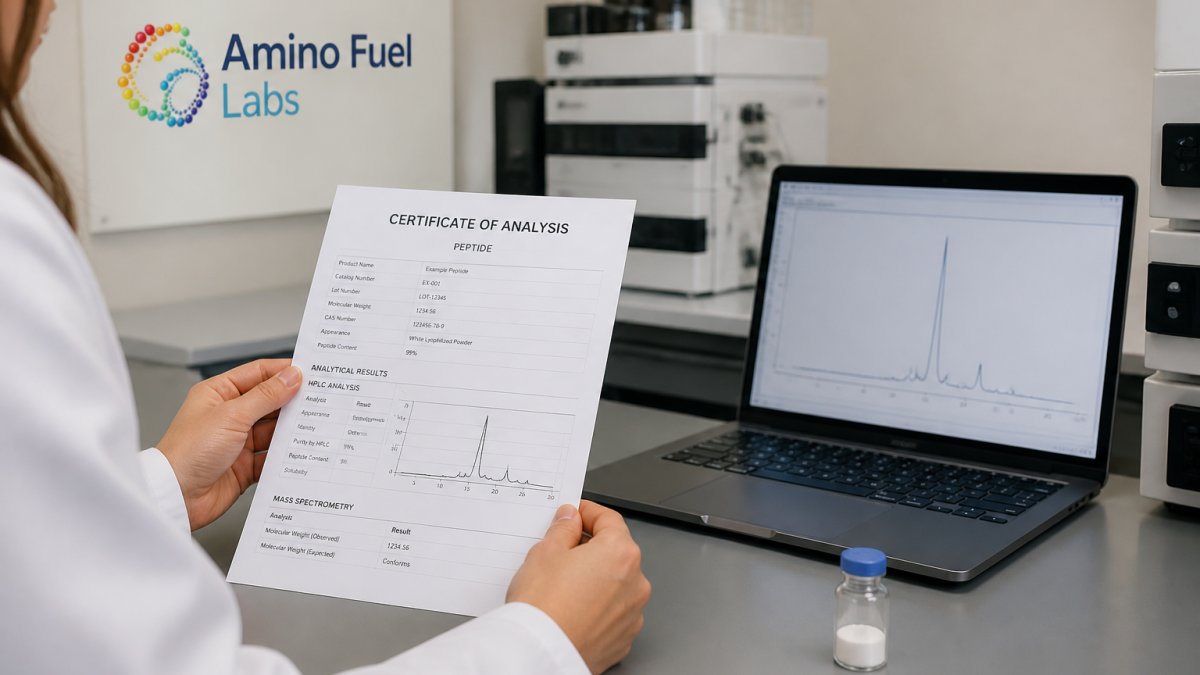
The gap most guides leave open is the workflow: how do you actually match a CoA to the vial in your hand, confirm the methods are appropriate, and verify the sample identity?
Step 1: Match the lot number and sample identity
Start with the vial label. The lot number on the CoA must match the lot number on the vial exactly, including any suffixes or prefixes. A CoA that lists a different lot, a range of lots, or no lot at all is not lot-specific documentation.
Next, confirm the sample identity fields: peptide name, sequence (if provided), molecular weight, and salt form. If the CoA lists a sequence that differs from the product label, stop and ask the vendor to reconcile it.
Step 2: Verify the test methods are named and appropriate
A credible CoA names the methods specifically, such as RP-HPLC with a stated column, gradient, and detection wavelength, and mass spectrometry with a stated ionization mode and mass range. Generic entries like "HPLC" or "MS" without method detail are not enough to audit.
Check that the methods match the claims. Purity should be supported by a chromatographic method, and identity should be supported by mass spectrometry.
Step 3: Confirm the testing laboratory and its independence
The CoA should identify the testing laboratory by name. If the lab is the vendor's own in-house facility, that is not independent third-party testing. Look for a lab name that is separate from the vendor and, where possible, confirm the lab's accreditation scope covers the tests reported.
Step 4: Check the test date and lot coverage
The test date should fall within a reasonable window for the lot and should not predate the lot's manufacture. A CoA dated years before the lot was produced is a red flag. Confirm the report covers this specific lot, not a representative batch or a historical specification.
Step 5: Review the raw data, not just the summary
The CoA should include the chromatogram and the mass spectrum, not only a pass/fail summary. Look for retention time, peak area, integration parameters, and the observed mass-to-charge values. A summary table with no trace behind it is easy to produce and impossible to audit.
Step 6: Cross-check the molecular weight and purity calculation
Compare the observed mass on the CoA to the theoretical molecular weight for the stated sequence. A close match within a tight tolerance supports identity. Also check whether the CoA reports peptide content or net peptide weight alongside purity; purity by peak area and peptide content by mass are not the same measurement.
If any step fails, ask the vendor for the missing documentation. A supplier that cannot produce raw data for a specific lot has not verified anything.
Third-Party Peptide Testing Labs: How to Evaluate Competence
An independent laboratory is only useful if it is genuinely independent and genuinely competent. Both parts matter, and most guides stop at "use a third-party lab" without explaining how to tell a competent lab from one that simply issues a number.
Here is how to assess a lab's competence in practice.
Accreditation and scope
Accreditation is not a single badge; it has a scope. Ask whether the lab holds accreditation for the specific tests it runs, such as RP-HPLC purity analysis and mass spectrometry identity confirmation, and whether the accreditation covers the matrices and methods used for peptides. A lab accredited for water testing but not for peptide analysis is not a peptide testing lab in any meaningful sense.
Method validation
A competent lab can show validation data for accuracy, precision, specificity, linearity, and robustness. Ask whether the methods are validated for peptides specifically, since peptide behavior on a column can differ from small-molecule behavior. A lab that cannot describe its validation approach is asking you to trust an unverified method.
Detection and quantitation limits
Purity percentages are only meaningful alongside the method's limit of detection (LOD) and limit of quantitation (LOQ). A method with a high LOQ can hide impurities that a tighter method would report. Ask the lab to state its LOD and LOQ for the peptide methods used, and compare those limits across labs before comparing purity numbers.
Reference standards and calibration
Calibration against certified reference materials supports accuracy. Ask whether the lab uses certified reference standards for the peptide or a structurally related standard, and how often calibration is verified. A lab that calibrates against an in-house standard of unknown purity is introducing uncertainty into every result.
Reporting depth and raw-data availability
A competent lab releases raw data, including chromatograms, spectra, integration parameters, and method details, not only a pass/fail summary. Ask in advance whether raw data is available and whether it is included in the standard report or available on request. A lab that will not release raw data is giving you a number, not quality verification.
Independence and conflict of interest
Independence means the lab has no financial relationship with the vendor beyond the testing contract. Ask whether the lab is owned by, affiliated with, or paid on a contingency basis by the vendor. A lab that depends on vendor volume for its revenue has an incentive structure worth understanding.
A lab that meets these criteria gives you something you can audit. A lab that does not gives you a document that looks like verification without the substance.
Sample Handling, Chain of Custody, and Suspicious Results
Sample integrity can undo good analytical work. A peptide that degraded in transit or absorbed to a container wall will test poorly even if it left the facility clean.
Basic handling rules:
- Store lyophilized peptide cold and dry, and follow the vendor's stated storage conditions
- Reconstitute with the recommended solvent and avoid repeated freeze-thaw cycles
- Record the lot number, reconstitution date, and storage conditions in your lab notebook
Chain of custody matters when results are disputed.
Now, suspicious results. If a CoA looks too clean, or the same report appears across multiple lots, treat it as a documentation failure until proven otherwise.
This is where vendor transparency earns its keep. At Amino Fuel Labs, we provide lot-matched third-party CoAs and accessible HPLC and MS lab reports so you can audit the record rather than take our word for it.
Conclusion
Verifying peptide purity is a documentation exercise as much as a laboratory one. Read the chromatogram, confirm identity with mass spectrometry, and check that the CoA is lot-specific and backed by raw data. No single percentage carries the whole story.
If you want research materials where the paperwork holds up to scrutiny, Amino Fuel Labs ships every lot with third-party Certificates of Analysis, HPLC purity documentation, and fast fulfillment, backed by 24/7 support.
Frequently Asked Questions
Does an HPLC purity result confirm a peptide's identity?
No. HPLC measures how much of the material elutes as a single main peak, which reflects purity, not identity. A high purity percentage can still belong to the wrong sequence. Identity is confirmed separately by mass spectrometry, which checks the observed molecular mass against the theoretical mass of the intended peptide. Treat HPLC and MS as complementary tests: one tells you how clean the sample is, the other tells you what the sample actually is. A Certificate of Analysis should report both.
How can I tell whether a peptide Certificate of Analysis matches its lot?
Check that the lot number on the CoA matches the lot number printed on the vial label exactly, including any suffixes. Confirm the test date falls before the ship date, and that the reported peptide name and molecular weight match the product you ordered. Look for a named analytical laboratory and a method description rather than a bare percentage. If the CoA has no lot number, or the lot number differs from the vial, ask the supplier for a lot-matched report before using the material.
What purity should my peptides be?
For most laboratory research, 95% or higher by HPLC is a common baseline, and 98% or above is typical for sensitive work such as cell culture or assays where impurities could skew results. The number matters less than the documentation behind it: a batch-specific CoA with a chromatogram, a mass spectrometry result, and a named testing laboratory tells you more than a headline percentage alone. Ask what the purity figure is measured against, since area percentage excludes moisture, salts, and residual solvents.
Where can I test my peptides for purity?
Independent analytical laboratories that offer reversed-phase HPLC and mass spectrometry will test a submitted sample, usually for a per-sample fee with turnaround measured in business days. Before sending material, ask which methods they run, whether they report raw chromatograms and spectra, and how they handle sample intake and chain of custody. For a purchased peptide, the simpler first step is to request a lot-matched third-party CoA from the supplier and verify the laboratory named on it.