
Table of Contents
- What Separates Reliable Research Grade Peptides Sources From the Rest
- How to Verify a Peptide COA Before You Trust It
- What a Lot-Matched Certificate of Analysis Actually Tells You
- Peptide HPLC Purity Testing: What It Proves and What It Misses
- Independent Third-Party Testing and Laboratory Accreditation
- Your Research Peptide Supplier Checklist
- Regulatory Boundaries and Research-Use-Only Disclaimers
- Conclusion
- Frequently Asked Questions
Last Updated: October 19, 2026
What Separates Reliable Research Grade Peptides Sources From the Rest
Reliable research grade peptides sources share one trait: documentation you can check yourself, not a purity claim in a listing, but a lot-matched third-party Certificate of Analysis tying a specific batch to a specific vial. (Source: ISO/IEC 17025 standard)
At Amino Fuel Labs, every product ships with lot-matched third-party Certificates of Analysis and accessible HPLC and MS lab reports, because a purity percentage means nothing if you cannot trace it to a batch.
Most guides rank suppliers by catalog size and price, then mention testing as a footnote.
So how do you tell them apart? Four signals matter most:
- Lot-specific documentation, not a generic sample COA reused across batches
- Named independent laboratories with traceable methods and accreditation
- Batch traceability from synthesis through shipping
Below, we walk through how to verify each one before you place an order.
How to Verify a Peptide COA Before You Trust It
Verifying a peptide COA means matching the document to your vial, confirming the issuing laboratory is real and independent, and checking that methods and results are internally consistent. Skip any step and you are trusting a PDF, not a test result.
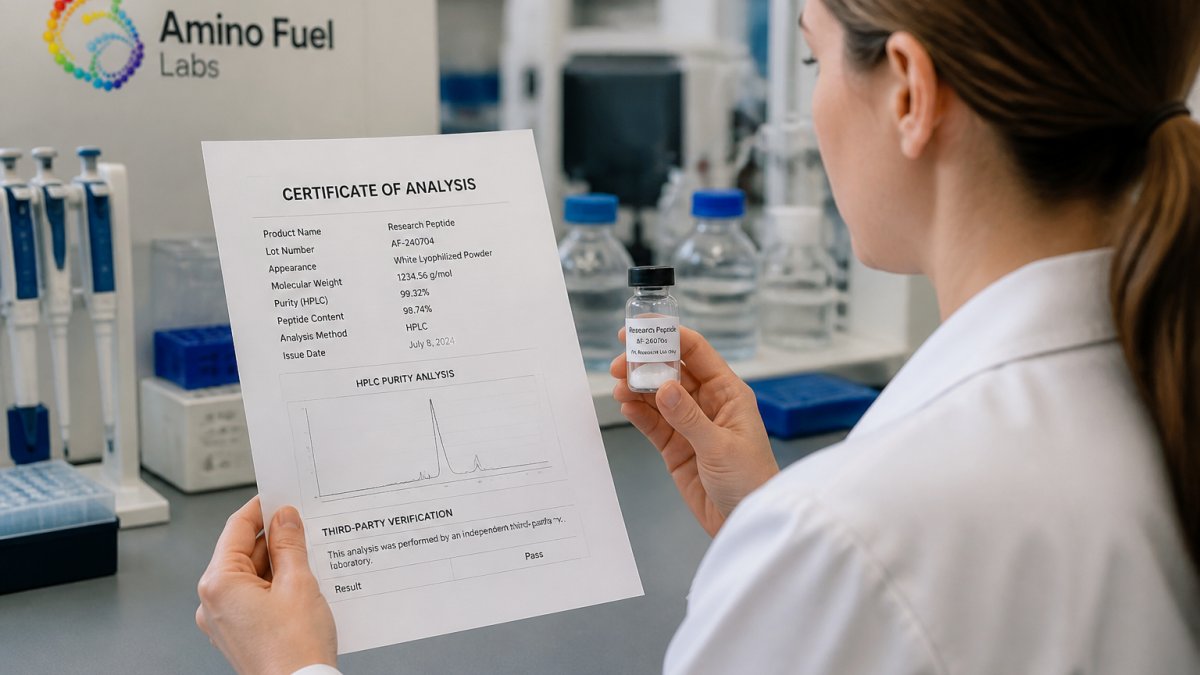
Below is our five-step verification sequence, followed by the red flags that separate a verifiable report from a generic or vendor-produced document.
Step 1: Match the Lot Number to Your Vial
The lot number on the COA must match the lot number on the vial you received, the step most buyers skip.
A common mistake is accepting a COA that lists a different batch than the one shipped; suppliers that test once and reuse the certificate leave you with no idea what is in your vial. Compare numbers character by character, including any suffix or revision letter.
Step 2: Confirm the Testing Laboratory Is Real and Independent
Look for a named laboratory, not a logo. Then verify three things:
- The laboratory exists as an operating entity. Search the name in a business registry or its website. No address, phone number, or published method list is a red flag.
- The laboratory is independent of the supplier. If the lab shares an address, ownership, or parent company with the vendor, the analysis is in-house testing wearing a third-party label.
- The laboratory is accredited for the methods it ran. ISO/IEC 17025 is the standard for testing competence, and accreditation bodies publish searchable directories. Confirm the specific method (for example, HPLC purity or LC-MS identity) falls within the lab's accredited scope, not just that it holds a certificate for some other test.
Step 3: Read the Methods, Not Just the Results
A COA reporting "99% purity" without the method, column, mobile phase, detection wavelength, and integration parameters is not verifiable, the method section lets an independent reviewer judge whether the result is meaningful.
For HPLC, look for column type and dimensions, gradient or isocratic conditions, detection wavelength, and integration method. For mass spectrometry, look for ionization mode, expected versus observed mass-to-charge ratio, and mass accuracy.
Step 4: Check Internal Consistency
Verifiable COAs are internally consistent in ways generic documents are not:
- The compound name, molecular formula, and molecular weight on the COA match the product listing and the published literature for that peptide.
- The lot number on the COA matches the lot number on the vial label and the packing slip.
- The test date precedes the ship date and falls within a plausible window for the batch.
Inconsistencies are not proof of fraud, but ask the supplier to explain them before relying on the document.
Step 5: Ask the Supplier to Walk You Through the Chain
A supplier that can explain how a lot number flows from synthesis to the certificate to your vial has actually built the system. Ask who performed the test, what method was used, whether raw chromatograms and spectra are available, and what happens if a batch fails specification. Vague answers are the tell.
Red Flags That Suggest a Generic or Vendor-Produced Document
- The COA has no lot number, or the lot number does not match the vial.
- The testing laboratory is unnamed, or its name cannot be found in any accreditation directory.
- The document reports a purity percentage but no method, no chromatogram, and no mass spectrum.
No flag is conclusive alone, but together they separate documentation you can verify from documentation you can only admire.
What a Lot-Matched Certificate of Analysis Actually Tells You
A lot-matched COA tells you what a specific batch tested at, using stated methods, on a stated date, a snapshot of one production run, not a permanent guarantee.
It establishes identity, purity by the stated method, and often appearance and solubility, not how the material behaves in your assay, whether it is sterile, or whether it is free of every possible contaminant.
Peptide HPLC Purity Testing: What It Proves and What It Misses
Peptide HPLC purity testing measures the proportion of the sample that elutes as the target peak under specific chromatographic conditions.
The gap comes from moisture, salts, and counterions HPLC may not account for.
Mass spectrometry fills part of the gap by confirming molecular identity, which is why a COA should show both HPLC and MS data. Neither test proves the compound is safe, effective, or appropriate outside a laboratory.
Independent Third-Party Testing and Laboratory Accreditation
Independent third-party testing means the analysis was performed by a laboratory with no financial stake in the result. Verify that independence rather than assume it.
But independence is only one variable. A COA can be independent, accredited, and still tell you less than you think if methods and scope are not reported.
What Third-Party Testing Does and Does Not Establish
A typical research-grade peptide COA reports a subset of the following. It is worth knowing which ones you are looking at:
| Test | What It Establishes | What It Does Not Establish |
|---|---|---|
| HPLC purity | The proportion of UV-absorbing material that elutes as the target peak under the stated method | Absolute peptide content per milligram; absence of non-UV-absorbing contaminants |
| Mass spectrometry (LC-MS or ESI-MS) | Molecular identity, the observed mass matches the expected mass | Purity; sterility; endotoxin; biological activity |
| Karl Fischer or loss on drying | Water content, which affects net peptide mass | Purity of the peptide itself |
| Amino acid analysis | Composition and, in some cases, peptide content | Sequence confirmation; sterility |
| Endotoxin testing (LAL) | Endotoxin burden in the sample | Sterility; absence of other microbial contaminants |
| Sterility testing | Absence of viable microbial growth under the test conditions | Endotoxin; viral contamination |
| Residual solvents (GC) | Solvent residues from synthesis and purification | Heavy metals; elemental impurities |
| Heavy metals (ICP-MS) | Elemental impurity levels | Organic impurities; endotoxin |
Most research-grade COAs report HPLC purity and mass spectrometry identity; fewer report endotoxin, sterility, residual solvents, or heavy metals. If your protocol requires any of the latter, ask specifically, do not assume a high purity figure covers them.
Why the Method Matters as Much as the Result
Two laboratories can run HPLC on the same sample and report different purity figures, because purity is method-dependent. A shallow gradient on a C18 column at 214 nm resolves different impurities than a longer gradient at 220 nm.
Mass spectrometry has the same issue. An LC-MS report showing the expected mass-to-charge ratio confirms identity, but a low-resolution single-quadrupole result is weaker evidence than a high-resolution accurate-mass result.
Laboratory Independence and Accreditation: What to Check
ISO/IEC 17025 is the international standard for testing laboratory competence. Accreditation bodies publish searchable directories, and a laboratory's accredited scope lists the specific methods it has been assessed for. Confirm:
- The laboratory is listed in an accreditation directory.
- The specific method (for example, HPLC purity or LC-MS identity) is within the accredited scope.
- The laboratory is independent of the supplier, no shared ownership, address, or parent company.
A laboratory that cannot be found in an accreditation directory, or will not be named at all, gives you nothing to verify. A named laboratory outside the accredited scope for the method it ran is only slightly better.
A Transparent Scoring Rubric for Comparing Suppliers
Most comparison articles rank suppliers by catalog size, price, and marketing polish, not a reproducible method. Here is the rubric we use. Score each item 0, 1, or 2, and treat a missing answer as a 0.
| Criterion | 0 | 1 | 2 |
|---|---|---|---|
| Lot-matched COA | Not provided | Provided on request | Provided with every order, lot-matched |
| Laboratory identity | Unnamed | Named but unverifiable | Named, independent, and verifiable in an accreditation directory |
| Methods reported | Result only | Method named | Full method parameters and raw data available |
| Tests beyond purity | None | HPLC + MS | HPLC + MS + endotoxin, sterility, or residual solvents as applicable |
| Batch traceability | None | Lot number only | Documented chain from synthesis to shipment |
| Research-use-only terms | Absent or hedged | Stated | Stated consistently across product, label, and marketing |
| Storage and handling | Not provided | General guidance | Compound-specific guidance |
| Documentation responsiveness | No response | Slow response | Answers documentation questions before purchase |
A supplier scoring 12 or above is doing more than most; below 6 is a marketing operation with a catalog.
What Third-Party Testing Does Not Cover
Even a strong COA does not certify the supplier's manufacturing practices, storage conditions, or shipping handling. A strong COA can coexist with weak lot-level quality control, so if consistency across batches matters, ask about retesting intervals, packaging, and shipping conditions too.
Your Research Peptide Supplier Checklist
Use this checklist before you commit to any research peptide supplier. Score each item honestly, and treat a missing answer as a no.
- <input disabled type="checkbox"> Does the supplier provide a lot-matched Certificate of Analysis for the exact batch you receive?
- <input disabled type="checkbox"> Does the COA name the independent laboratory that performed the testing?
- <input disabled type="checkbox"> Can you find that laboratory in an accreditation directory for the methods listed?
| Verification Step | What to Request | What It Confirms |
|---|---|---|
| Lot matching | COA with your batch number | The document describes your material |
| Lab identity | Laboratory name and location | Testing was not done in-house |
| Accreditation | ISO/IEC 17025 scope | The lab is competent for the method |
| Method review | HPLC and MS data | Identity and purity, with limits stated |
| Traceability | Batch records on request | Consistency across production runs |
Regulatory Boundaries and Research-Use-Only Disclaimers
Research-use-only labeling exists because these compounds are not approved drugs.
A supplier that markets research grade peptides with dosing guidance, before-and-after claims, or wellness promises is signaling how it views the rules, and documentation quality tends to track the same way.
Keep purchases, records, and use clearly within laboratory research. If your institution has compliance requirements around supplier documentation and traceability, confirm the supplier can support an audit before you order rather than after.
Conclusion
The reliable sources are not the ones with the biggest catalogs or the loudest claims. They hand you a lot-matched certificate, name the laboratory, and answer documentation questions without flinching.
Amino Fuel Labs was built for exactly that standard. We provide 99%+ HPLC purity targets, lot-matched third-party Certificates of Analysis, accessible HPLC and MS lab reports, fast U.S. shipping, and 24/7 support so your records hold up when someone asks.
Frequently Asked Questions
What should a third-party Certificate of Analysis include?
A useful COA should name the peptide, state the lot or batch number, and list the analytical methods used, typically HPLC for purity and mass spectrometry for identity. It should show the actual measured results, not just a pass or fail, and identify the independent laboratory that ran the tests. Look for a purity percentage, a retention time, and a mass value that matches the expected molecular weight. A document with no lot number or no lab name is not verifiable and should not be treated as proof of quality for research grade peptides.
How can I verify that a COA matches a peptide product lot?
Start by checking that the lot number on the COA matches the lot number printed on the vial label and the packing slip exactly. Then contact the testing laboratory named on the document through its own published contact details, not a link supplied by the seller, and ask whether the report number exists. Reputable suppliers will also explain their lot-matching system if your institution needs to audit it. If the seller cannot connect a specific vial to a specific report, the documentation is decorative rather than traceable.
Does an HPLC purity result confirm a peptide's identity?
No. HPLC purity testing measures how much of the detected material elutes as a single peak, which tells you the sample is largely one substance, not that the substance is the peptide you ordered. Identity needs a separate method, usually mass spectrometry, to confirm the molecular weight. A related trap is that purity percentage can be reported on different bases, so a sample containing moisture and counterions may show a lower peptide content than the headline purity figure suggests. Ask for both tests and for the basis on which purity was calculated.
What questions should I ask a peptide supplier before ordering?
Ask which independent laboratory performs the testing and whether it holds accreditation such as ISO 17025. Ask for a lot-matched Certificate of Analysis before you buy, not after. Ask whether the COA includes identity testing by mass spectrometry alongside HPLC purity, and how moisture and salt content are accounted for. Ask about storage conditions, shipping temperature, and typical turnaround. Finally, ask how they handle a batch that fails specification. Suppliers who answer these plainly are easier to trust than ones who send a generic certificate with no lot number.