
Last Updated: October 30, 2026
Quick Summary
Research peptides for sale are worth buying only when the supplier backs them with lot-specific, third-party Certificates of Analysis that show HPLC purity and mass spectrometry identity. Check the testing laboratory, confirm the lot number matches your vial, and compare cost per milligram of net peptide content.
- Request a lot-specific COA, not a generic sheet, for every product you plan to buy.
- Confirm purity was tested by an independent laboratory, not only in-house.
- Divide vial price by net peptide content to get a fair cost per milligram.
- Factor shipping, minimum orders and rejected lots into your total cost.
- Keep lot numbers with your study records to allow traceability.
Table of Contents
- What Research Peptides Are and Who Buys Them
- How to Evaluate Research Peptide Suppliers
- Reading a Research Peptide Certificate of Analysis
- Peptide Purity Testing: What the Percentage Does and Does Not Tell You
- Comparing Pricing, Vial Sizes and Total Cost
- Research Peptide Storage After Delivery
- Booking Your First Order and Documentation Request
- Frequently Asked Questions
Research peptides are sold online to laboratories, and the quality of what arrives depends almost entirely on the documentation behind it. Lot-matched third-party Certificates of Analysis and HPLC purity reports are the documents a buyer should review, and knowing how to read them matters. Here is how to evaluate research peptides for sale before you place an order.
What Research Peptides Are and Who Buys Them
Research peptides are short chains of amino acids supplied for laboratory investigation, and they are sold strictly for research use only. They are not approved drugs, supplements, or consumer products. Buyers include principal investigators at academic institutions, independent researchers running exploratory experiments, and laboratory teams that need consistent compounds across studies.
The "research use only" label defines the boundary of the sale. What RUO labeling permits and the documentation to expect is explained separately. It means the material is intended for laboratory study, not for human or animal consumption or treatment. Any supplier that markets research peptides for personal use is operating outside that boundary, and a careful buyer will notice.
How to Evaluate Research Peptide Suppliers
Before comparing prices, check whether a supplier can document what it sells. Four questions do most of the work:
- Does each product come with a lot-specific Certificate of Analysis, not a generic sheet?
- Is purity tested by an independent laboratory, or only in-house?
- Can the supplier confirm identity, usually by mass spectrometry, alongside purity?
- Is there a traceable lot record linking the vial you receive to the test results?
A supplier that cannot answer these questions clearly is asking you to trust claims you cannot check. A checklist for comparing suppliers covers the red flags worth avoiding. Lot traceability matters most for multi-study programs, because it lets you tie a result back to the exact material used. Lot traceability records to request before you buy are set out in a separate guide.
Reading a Research Peptide Certificate of Analysis
A Certificate of Analysis, or COA, is the document that records what was tested and what was found. Reading it takes about five minutes once you know the layout.
What a COA should include
A complete COA lists the product name, the lot or batch number, the test date, and the testing laboratory's name. It should report purity from HPLC, identity from mass spectrometry, and the measured quantity or net content where relevant. Look for the analytical method named, not just a result. A purity figure with no method attached tells you very little.
How to verify a COA is independent
Check the laboratory's name and contact details, then confirm the lot number on the COA matches the label on your vial. A step-by-step method for checking purity and identity results shows how to confirm they are reliable. Ask whether the lab holds an accreditation recognized for analytical testing, and request documentation of it if it is not published. A COA that names no laboratory, or lists the supplier's own address as the testing site, deserves scrutiny. Independence is the point of third-party testing, so an in-house report is a weaker form of evidence even when it looks professional.
Peptide Purity Testing: What the Percentage Does and Does Not Tell You
A purity percentage is the headline number on most COAs, and it is easy to over-read. HPLC, or high-performance liquid chromatography, separates the sample into components and measures the share that elutes as the target peptide. Mass spectrometry then confirms that the main peak has the expected molecular weight.
What the percentage does not capture is just as important. HPLC purity is measured relative to the detected peaks, so it does not automatically account for water, residual salts, or counterions that add weight without showing up as impurities. How purity percentages are calculated and what testing cannot show is explained in a separate guide. Two vials labeled 99% can contain different amounts of actual peptide by weight. Read purity as one piece of evidence, alongside identity and quantity, rather than as a complete measure of what is in the vial.
Comparing Pricing, Vial Sizes and Total Cost
Pricing for research peptides is often quoted per vial, and the vial is frequently not the unit your protocol actually consumes. To compare suppliers honestly, convert every quote to a cost-per-milligram figure and then add the costs that sit outside the sticker price. Researchers sometimes compare only the headline vial price and discover the gap at checkout.
The cost-per-milligram conversion
Take the stated net peptide content, not the gross vial weight, and divide the vial price by it. A 5 mg vial priced at $60 is $12 per mg; a 10 mg vial priced at $110 is $11 per mg. The larger vial wins on unit cost, but only if your protocol can use the full amount before degradation. If you need 2 mg for a pilot, buying the 10 mg vial to save $1 per mg can be a false economy once storage losses are counted.
Watch for two traps in this conversion:
- Gross weight versus peptide content. Some labels list total vial contents including counterions and residual moisture. A 10 mg vial may contain meaningfully less than 10 mg of the target peptide. The COA's net content or peptide content line is the number to use.
- Purity-adjusted cost. A 98% pure vial and a 95% pure vial at the same price are not the same value. Divide the cost-per-mg by the purity fraction to get cost per milligram of target peptide.
Bulk, wholesale, and custom synthesis pricing
Ask suppliers for their full quantity-based pricing rather than relying only on the single-vial price.
If your work requires a non-catalog sequence, ask the supplier whether custom synthesis is available and request a quote before assuming a catalog product will substitute.
The costs that sit outside the vial price
Total cost of ownership for a research peptide order includes several line items that do not appear on the product page:
- Shipping and handling. Cold-chain or expedited shipping can add a meaningful percentage to a small order. Consolidating orders reduces per-vial shipping cost.
- Minimum order thresholds. Some suppliers waive shipping above a threshold or require a minimum order to process at all. Know the threshold before you build a cart.
- Documentation costs. A lot-specific third-party COA is sometimes bundled and sometimes a paid add-on. A cheaper vial without usable documentation is not cheaper for a study that needs an audit trail.
- Rejected or failed lots. Budget for the possibility that a lot does not meet your acceptance criteria. The effective cost of a supplier is the price divided by the fraction of lots you actually accept.
- Storage and aliquoting consumables. Cryovials, desiccant, and freezer space are real costs in multi-month programs.
Pricing depends on quantity, vial size and delivery options. Check the Amino Fuel Labs website for current prices, and request a quote for bulk or custom orders before purchase.
The sticker price is only part of the picture, so the article recommends comparing the costs that sit outside the vial.
| Cost item | What to check | Why it matters |
|---|---|---|
| Cost per mg | Vial price divided by net peptide content | Gives a fair comparison across vial sizes |
| Purity-adjusted cost | Cost per mg divided by purity fraction | Shows value of target peptide |
| Shipping and handling | Cold-chain or expedited fees | Can add a large share to small orders |
| Minimum order thresholds | Waived shipping or order minimums | Affects how you build your cart |
| Documentation | Whether a lot-specific COA is bundled | Missing audit trail costs more later |
| Rejected lots | Share of lots that fail your criteria | Raises the effective cost per accepted lot |
| Storage consumables | Cryovials, desiccant, freezer space | Real costs in multi-month programs |
Research Peptide Storage After Delivery
Storage affects the material after it leaves the supplier. Follow the storage instructions printed on the product label and on the COA, which should specify storage conditions. Record the date of receipt, keep the lot number with your study records, and avoid repeated freeze-thaw cycles by aliquoting material where your protocol allows.
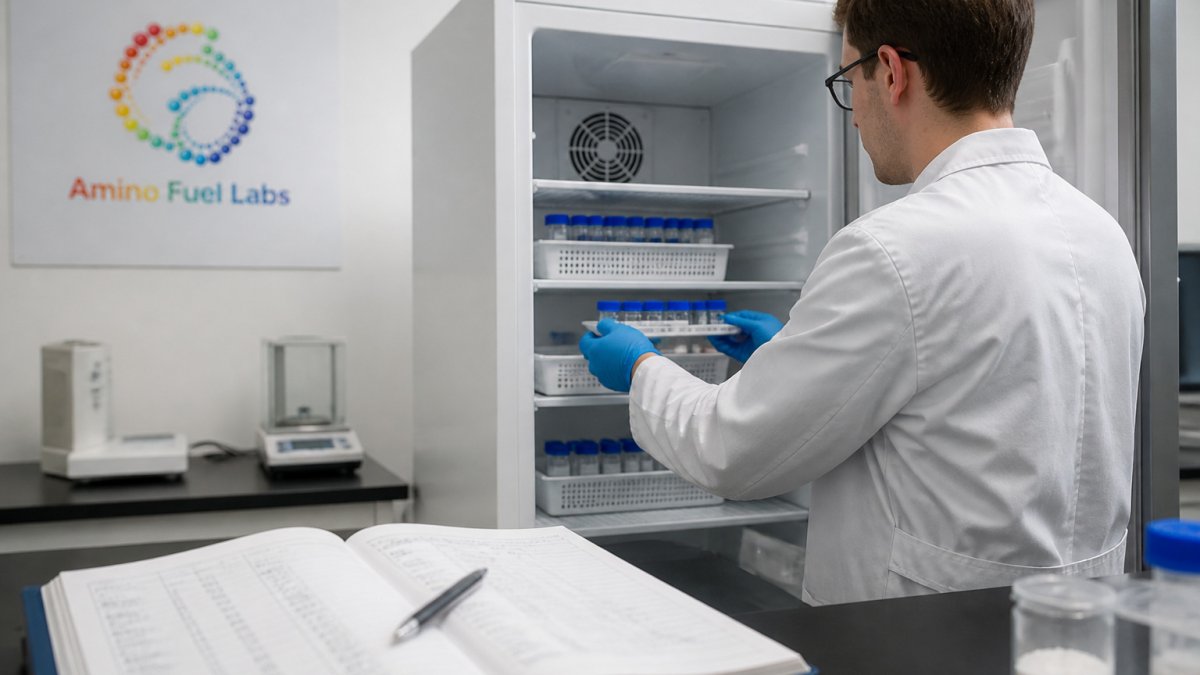
Keeping lot records alongside vials lets a lab trace any later question back to the source, which is useful during an audit or a method review.
Booking Your First Order and Documentation Request
Before placing a first order, request the documentation you will need for your records. Ask for the lot-specific COA for the product you intend to buy, confirmation of the testing laboratory, and the lot traceability details. If your institution has supplier documentation requirements, send them to the supplier before ordering so there is no delay at the compliance stage.
When you are ready, you can review the available research peptides on the Amino Fuel Labs website. Ask the supplier about minimum order sizes and delivery timing for your situation before you commit, particularly if you are running a small pilot study.
Frequently Asked Questions
How do you evaluate a research peptide supplier?
Start with documentation. A reliable supplier provides a lot-specific Certificate of Analysis, HPLC purity data and mass spectrometry results for each product, not a generic sheet. Check whether the testing lab is named and independent, whether the batch number on the COA matches the vial you receive, and whether the supplier states clearly that its products are for research use only. Ask about shipping times, order tracking and support response. Compare what each provider actually documents rather than the purity figure alone, and request a sample COA before placing a larger order.
What should a peptide Certificate of Analysis include?
A useful COA lists the peptide name and sequence, the lot or batch number, the test date, the analytical method used (typically HPLC for purity and mass spectrometry for identity), the measured purity and the observed molecular weight. It should also identify the testing laboratory. Check that the lot number on the document matches your vial. If any of these elements is missing, or the document looks identical across different batches, ask the supplier for clarification before you rely on the data in your research.
How can you verify a peptide's purity?
Purity is usually reported as a percentage from HPLC, which measures how much of the sample is the target peptide compared with other material. Mass spectrometry confirms that the main peak has the expected molecular weight. A high HPLC percentage does not account for water, counterions such as trifluoroacetate, or residual salts, so the actual peptide content by weight can be lower than the purity figure suggests. Ask suppliers whether they report net peptide content, and review the chromatogram itself when it is available.
Should researchers check anything else before ordering peptides online?
Confirm that the product is labeled for research use only and that your intended use fits that label. Check your institution's supplier approval and traceability requirements, including whether you need lot-level documentation for audits. Ask about minimum order quantities if you run small pilot studies, and request information on custom synthesis lead times for less common sequences. Pricing depends on quantity, vial size and delivery options, so request a current quote from the supplier rather than relying on published figures.
