

Last Updated: October 26, 2026
Quick Summary
Peptide supplier lot traceability requirements mean a unique lot identifier on the vial must link to a manufacturing record and a lot-matched third-party certificate of analysis. For research-use-only peptides these records are voluntary best practice, not a federal mandate, so you choose a quality standard rather than comply with a minimum.
- A defensible lot record bundles manufacturing, analytical, shipment and receiving inspection records under one identifier.
- Verify a lot in four steps, including asking the supplier to confirm the lot exists in their records.
- Every split, repackage or relabel should create a child identifier that records its parent lot.
- Digital records need immutable supplier lot numbers, user attribution, timestamping and no silent edits.
- Send five written documentation requests to a supplier before you place your first order.
Table of Contents
- What Peptide Lot Traceability Actually Requires
- The Peptide Supplier Documentation Checklist
- Reading a Lot-Matched Certificate of Analysis
- Peptide Batch Number Verification in Practice
- Building a Peptide Chain of Custody From Receipt to Disposal
- How Lot Peptide Traceability Breaks: Relabeling, Split Lots and Document Fraud
- Auditing a Supplier's Traceability System Before You Order
- Frequently Asked Questions
What Peptide Lot Traceability Actually Requires
Peptide supplier lot traceability requirements describe the documented link between a specific vial and the manufacturing record, analytical testing, and handling history behind it, and those peptide supplier lot traceability requirements are what we treat as the product, not paperwork. At Amino Fuel Labs, we treat that link as the product, not paperwork.
The requirement breaks into three connected parts:
- A unique lot identifier assigned at fill and printed on the container label
- A manufacturing record that ties raw material intake, synthesis, and fill date to that identifier
- A lot-matched certificate of analysis (COA) produced by a third-party laboratory against the same identifier
Miss any one and the chain is broken. The compound may still be fine, you just cannot prove it.
Which Requirements Actually Apply to Research-Use Peptides
Most search results blur three rule sets together: food traceability law, drug manufacturing guidance, and voluntary supplier quality practice. Legal obligations for a research-use peptide are narrower, so map your product and business context to the right column before building a documentation program.
| Context | Primary federal framework | What it actually obligates you to do |
|---|---|---|
| Research-use-only peptide sold for laboratory work, not for human or animal use | Not regulated as a drug or food; general FTC advertising and labeling truthfulness rules apply | No mandated lot record format. Traceability is a voluntary quality control you adopt to protect data integrity. |
| Peptide sold or represented for human use | FDA drug framework, including current good manufacturing practice (cGMP) requirements in 21 CFR Parts 210 and 211 | Batch production records, lot numbering, and retention of records tied to each batch |
| Peptide used as a food ingredient or in a dietary supplement | FDA food facility rules under 21 CFR Part 117 and, where applicable, FSMA traceability requirements in 21 CFR Part 1 Subpart S | Lot-level records, traceability lot codes, and rapid retrieval of records on request |
| Any peptide imported into the United States | U.S. Customs and Border Protection entry requirements plus FDA import rules | Accurate entry documentation and, for regulated categories, prior notice |
The practical takeaway: for a research-use-only peptide, most of what a strong supplier publishes, lot-matched COAs, manufacturing record summaries, chain-of-custody logs, is voluntary best practice, not a federal mandate.
The Records That Must Connect to a Lot Number
A defensible lot record is a bundle, not a single document. These records should all carry the same identifier and be retrievable on request:
- Manufacturing record: synthesis date, fill date, quantity produced
- Analytical record: HPLC and mass spectrometry identity testing, purity percentage, assay result
- Shipment record: outbound date, packaging, cold chain handling if applicable
For a deeper walkthrough of how lot identifiers link a physical vial to its analytical record, see our explainer on lot numbers, COA matching, and chain of custody. The principle: if a record does not carry the lot number, it does not belong to that vial.
The Peptide Supplier Documentation Checklist
Use this peptide supplier documentation checklist before your first order and at every supplier review. A supplier that cannot produce these items on request has built a catalog, not a traceability system.
- <input disabled type="checkbox"> Lot number printed on the container label, not just the outer box
- <input disabled type="checkbox"> Lot-matched third-party COA, with the testing laboratory named
- <input disabled type="checkbox"> Analytical methods stated: HPLC for purity, mass spectrometry for identity
A common mistake is accepting a COA that matches the product name but not the lot. Product-level documentation tells you what a compound should be. Lot-level documentation tells you what this vial is.
Reading a Lot-Matched Certificate of Analysis
A lot-matched certificate of analysis is only useful if the identifier on the certificate matches the identifier on your vial, character for character. Check that first. Everything else is secondary.
Then read the document in this order:
- Lot number and product name. Confirm the match against your container label.
- Testing laboratory. An independent lab name and report number should appear. In-house results presented as third-party testing are a red flag.
- Identity testing. Mass spectrometry confirms the molecular weight matches the expected structure. HPLC confirms the main peak dominates the chromatogram.
- Purity percentage. Note the method and detection wavelength. A purity figure without stated methodology is not verifiable.
- Assay and net content. Purity and peptide content are different numbers. A vial can be highly pure and still contain less peptide than the label implies once moisture and counterions are accounted for.
Our field-by-field guide on how to read a certificate of analysis walks through each section and what it does and does not establish. The short version: a COA is evidence, not a guarantee.
Peptide Batch Number Verification in Practice
Peptide batch number verification is the step most researchers skip and the cheapest fraud check available, under a minute, and it catches the most common documentation failures.
Run it in four steps:
- Photograph the container label on arrival, before opening anything.
- Compare the lot number on the label to the lot number on the COA, digit by digit.
- Confirm the COA report number and testing date are consistent with the manufacturing date.
- Contact the supplier and ask them to confirm the lot exists in their records.
That fourth step matters. A supplier with a real traceability system confirms a lot number quickly; one working from templates will hesitate, deflect, or send a different document. A visually perfect COA that cannot be confirmed against the supplier's own records is worse than no COA, it creates false confidence in your data integrity.
Building a Peptide Chain of Custody From Receipt to Disposal
Chain of custody means every hand that touches the vial, and every storage condition it experiences, is written down. Start at the loading dock, not the bench, a chain that begins at the bench cannot answer what happened to this material before you opened it.
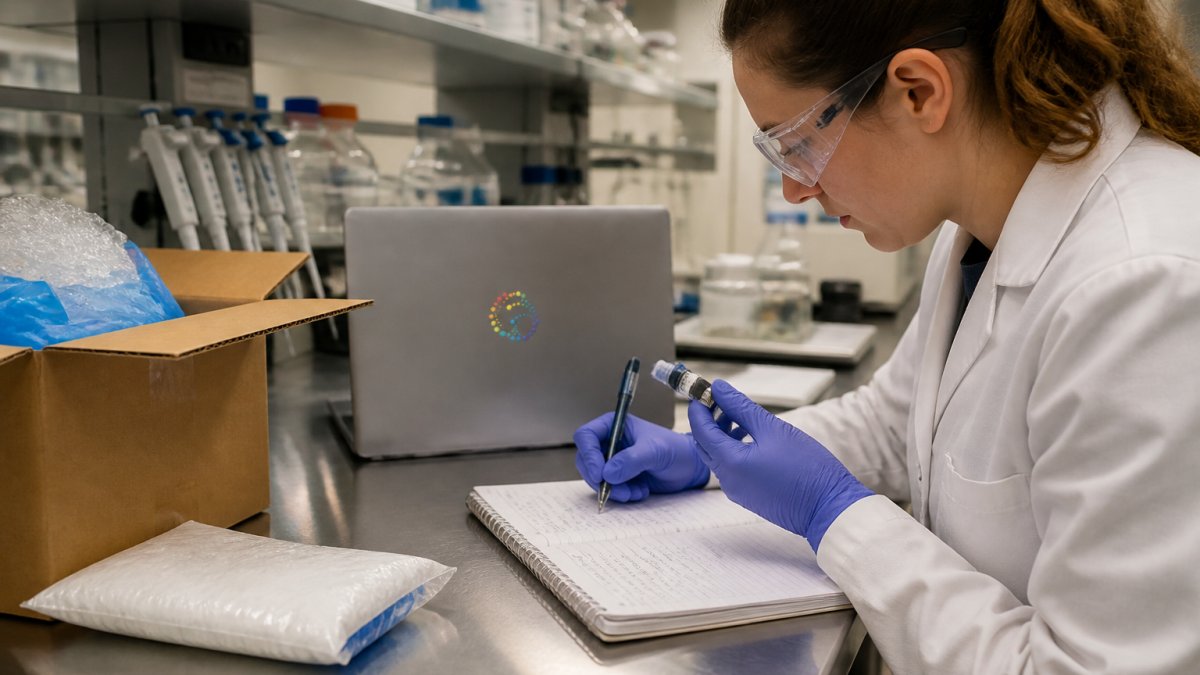
The workflow we recommend:
- Receiving inspection. Record arrival date, package condition, and internal temperature if a cold pack was included. Photograph the sealed container.
- Label verification. Confirm lot number against the COA before the vial enters inventory.
- Inventory record. Assign an internal identifier and log the storage location and conditions.
- Usage log. Record who withdrew the vial, date, quantity, and the experiment it served.
- Disposal record. Note disposal date and method.
Receipt is the first custody link. Our article on cold chain and transit for research peptides covers what to document on arrival and why lyophilized powder tolerates brief ambient exposure. Build the habit at intake and the rest of the chain follows. (Source: FSMA traceability requirements)
Preserving Parent-Child Lot Relationships
A single supplier lot frequently becomes many things in your lab: aliquots, working stocks, diluted solutions, material transferred to a collaborator.
The rule is simple: every time material is divided, repackaged, relabeled, or combined, create a new child identifier and record its parent. Never overwrite the supplier lot number, keep it as the root and add your internal identifiers beneath it.
A practical parent-child record needs, at minimum:
- Parent identifier, the supplier lot number exactly as printed
- Child identifier, your internal code for the aliquot, stock, or transfer
- Relationship type, aliquot, dilution, repackage, or pool
Handling Split Lots, Repackaging, and Relabeling
Split lots and repackaging are where most supplier-side traceability fails, and your intake process should assume they happen. When a shipment arrives in a container size or label format that differs from the COA, treat it as a documentation event, not a cosmetic one.
- Split lots. If one manufactured batch is divided across multiple container sizes, each container should carry an identifier that maps to the parent lot. Ask the supplier for that mapping in writing before you accept the shipment.
- Repackaging. If a supplier repackages bulk material into smaller vials, the new label must reference the original lot and the original analytical record. A new label without a new COA is a red flag, not a convenience.
- Relabeling. Any relabel should be documented with the old identifier, the new identifier, the reason, and the date. An undocumented relabel severs the chain.
When you receive a split or repackaged lot, log the parent-child mapping in your own records at intake. Do not rely on the supplier to hold the only copy of that relationship.
Digital Record Fields and Audit-Trail Controls
A paper notebook can satisfy a chain of custody for a small lab, but it does not scale or survive an audit well. Build the record around a small set of required fields and an audit trail that captures changes rather than overwriting them.
Minimum fields for a digital traceability record:
- Supplier lot number (immutable, as printed)
- Internal child identifier
- Parent-child relationship type
Audit-trail controls worth insisting on:
- No silent edits. Every change to a record should create a new version with the prior value retained.
- User attribution. Each entry should carry the identity of the person who made it.
- Timestamping. Use a consistent time zone and do not allow backdating without a recorded reason.
Most QMS, LIMS, and ERP platforms can hold these fields, but the integration is only as good as the discipline behind it.
How Lot Peptide Traceability Breaks: Relabeling, Split Lots and Document Fraud
Traceability fails in predictable ways, and most failures originate at the supplier, not the lab. Three patterns account for the majority.
Relabeling. A supplier buys material in bulk, repackages it, and issues a new label without a new analytical record.
Split lots. A single manufactured batch is divided across multiple container sizes or shipments, each given a different identifier, with documentation only for the parent lot.
Document fraud. Certificates are copied, edited, or generated from templates.
When traceability breaks, experiments fail in ways that look like technique problems. If you are troubleshooting unexplained variability, our companion piece on why research peptides fail experiments covers seven fixes worth checking before you blame your protocol.
Auditing a Supplier's Traceability System Before You Order
Ask for the audit before you order, not after a batch behaves oddly. A supplier with a functioning system welcomes the questions; one without will stall.
Send these five requests in writing:
- A sample lot-matched COA with the testing laboratory named
- Confirmation that lot numbers appear on container labels, not only outer packaging
- A description of how manufacturing records are linked to lot identifiers
- The name of the third-party laboratory used for identity and purity testing
- Confirmation of how a lot number can be verified after purchase
At Amino Fuel Labs, we publish lot-matched third-party Certificates of Analysis and accessible HPLC / MS lab reports for every product, so these questions have answers before you ask them. Before comparing quotes, read our guide to cost per milligram and honest peptide price comparison, which explains how to normalize price against net peptide content and documentation depth rather than sticker price alone.
One more practical note: a supplier that cannot tell you which laboratory ran the assay, or that treats the question as an intrusion, has told you something useful. Believe it.
Frequently Asked Questions
What are peptide supplier lot traceability requirements?
There is no single federal rule that spells out peptide lot traceability requirements for research-use materials. In practice, a defensible system links each vial's lot number to a manufacturing record, an independent certificate of analysis, a shipment record, and your own receiving and storage logs. The FDA's food traceability rule under FSMA Section 204 sets a model for lot-level recordkeeping but does not cover research peptides, so most labs adopt supplier qualification and internal documentation standards instead. Ask suppliers for lot-matched COAs and audit their recordkeeping before ordering.
What information should a peptide lot record include?
At minimum: the lot or batch number, peptide name and sequence, quantity, manufacturing date, expiry or retest date, purity result and analytical method (HPLC, mass spectrometry), storage conditions, and the identity of the testing laboratory. Add the purchase order, shipment tracking, receiving inspection notes, and the date the vial entered storage. A complete record also names who performed each step. If a supplier cannot produce these fields for a specific lot, treat that lot as unverified regardless of the purity percentage printed on the label.
How can researchers verify that a certificate of analysis matches a peptide lot?
Compare the lot number on the COA to the number printed on the vial label and the shipping paperwork. Check that the COA names the testing laboratory, the analytical method, and a report date that falls before the shipment date. Contact the third-party lab directly to confirm the report exists if the supplier allows it. Look for inconsistencies: identical COA layouts across different peptides, missing method details, or purity figures with no chromatogram attached are warning signs that the document was not produced for that specific lot.
What should a researcher do if a peptide shipment has a labeling or documentation discrepancy?
Quarantine the shipment and do not use the material. Photograph the vial, label, and packing slip, then compare the lot number against the COA and order record. Contact the supplier in writing, describe the discrepancy, and request a corrected document or replacement lot. Log the incident in your receiving records with the date and the person who handled it. If the supplier cannot resolve it with verifiable documentation, treat the lot as unsuitable for research and consider it when reviewing that supplier's qualification status.
How long can peptides be left unrefrigerated?
Stability depends on the specific peptide, its form (lyophilized powder versus reconstituted solution), and the storage conditions stated on the supplier's documentation. Lyophilized peptides are generally more tolerant of short transit times than reconstituted ones, but there is no universal safe window. Follow the storage conditions on the lot-specific COA and record the temperature and duration of any excursion. If a shipment arrives warm and the supplier's documentation requires cold chain, document the deviation and ask the supplier whether the lot was validated for that exposure.
Who is exempt from the FSMA 204 traceability rule?
The FDA's Food Traceability Rule applies to persons who manufacture, process, pack, or hold foods on the Food Traceability List, with limited exemptions for small retail food establishments and certain other operations defined in the rule. Research peptides are not foods on that list, so the rule does not govern peptide suppliers. It is still a useful reference for what a lot-level record should contain. Check the FDA's current guidance directly for the exact exemption criteria rather than relying on summaries.
Verifying a supplier's documentation system takes an afternoon. Living with an untraceable batch takes months. Amino Fuel Labs ships research peptides with 99%+ HPLC purity, lot-matched third-party Certificates of Analysis, and accessible HPLC and MS lab reports on every product, backed by fast U.S. fulfillment and 24/7 support. Get started with Amino Fuel Labs and build a research record you can defend.
