
Last Updated: October 23, 2026
Quick Summary
Small quantity research peptide suppliers fill orders below bulk thresholds, usually from a fraction of a gram up to a few grams per lot. Compare them on minimum order quantity, lot-specific documentation, and fulfillment speed, since the suppliers easiest to order from in tiny amounts are often the least able to prove what is in the vial.
- Minimum order quantities range from a single vial to multi-gram commitments, and published MOQs are inconsistent.
- A per-order dollar minimum can appear at checkout even when a supplier advertises no vial minimum.
- A lot-matched COA should reference the specific lot you receive, not a representative lot.
- Ask each supplier to quote price per milligram of peptide content so quotes are comparable.
- Research peptides are sold for laboratory research use only, not human or veterinary use.
Table of Contents
- Why Small-Quantity Orders Change How You Vet Research Peptide Suppliers
- Minimum Order Quantities Compared: What Small Labs Actually Face
- How to Compare Research Peptide Suppliers Without Getting Burned
- Research Peptides With Certificate of Analysis: What a Real COA Shows
- Third-Party Tested Research Peptides: Separating Proof From Marketing
- Pricing, Shipping, and Payment for Small Orders
- Red Flags and Research-Use Compliance
- Conclusion
- Frequently Asked Questions
Why Small-Quantity Orders Change How You Vet Research Peptide Suppliers
Small quantity research peptide suppliers fill orders below the bulk thresholds most manufacturers prefer, usually from a fraction of a gram up to a few grams per lot.
Small orders expose what bulk buyers never test.
The tension most buyers miss: the suppliers easiest to order from in tiny amounts are often the least able to prove what is in the vial.
- Minimum order quantity (MOQ) determines whether you can even start a pilot study
- Lot-specific documentation determines whether your results are defensible
- Fulfillment speed determines whether your timeline survives
Below, we break down how to compare these suppliers on the criteria that matter.
Minimum Order Quantities Compared: What Small Labs Actually Face
Minimum order quantities for research peptides range from a single vial to multi-gram commitments. Some suppliers advertise no minimum; others quietly require a gram or more per compound. Because published MOQs are inconsistent, compare the MOQ structure behind the number.
The Four MOQ Structures You Will Encounter
| MOQ Structure | What It Looks Like | Best Fit | Watch-Out |
|---|---|---|---|
| Per-vial minimum | One vial of any size, no dollar floor | Pilot assays, single-compound screens | Shipping cost can exceed product cost |
| Per-compound minimum | A set mass per peptide (e.g., a fraction of a gram) | Dose-ranging on one compound | Buying multiple compounds multiplies the floor |
| Per-order dollar minimum | "No MOQ" but a cart subtotal requirement | Mixed small orders | Defeats the purpose if you need one vial |
| Kit or catalog-only | Fixed kit sizes or catalog SKUs only | Reproducible standard panels | No custom sequence at small scale |
The per-order dollar minimum surprises buyers most because it appears at checkout, not on the product page. A supplier can truthfully say "no minimum" per vial and still require a cart subtotal.
Sample and Pilot-Batch Policies
Ask whether the supplier offers a sample size, pilot batch, or small custom synthesis run, each with different documentation expectations:
- Sample vial: a small quantity of an existing lot, usually the fastest path to a pilot assay. Confirm it ships with the same lot-matched COA as a full order.
- Pilot batch: a small custom synthesis run, useful when your sequence is not in the catalog. Lead time is longer and pricing is usually quoted per project.
- Custom sequence at low scale: confirm the smallest synthesis scale the supplier will quote and whether crude versus purified material is the default at that scale.
Questions to Ask in Writing
- What is the smallest quantity you will ship of a single compound?
- Is there a per-order minimum value separate from the per-vial minimum?
- Do sample sizes ship with the same lot documentation as full orders?
That last question matters: a reorder from a new lot mid-study changes your baseline, so ask how the supplier handles lot continuity.
How to Compare MOQs Side by Side
Build a comparison sheet before requesting quotes. For each supplier, record the per-vial minimum, per-compound minimum, per-order dollar minimum, sample availability, small-scale custom sequence quoting, and lot continuity on reorders.
How to Compare Research Peptide Suppliers Without Getting Burned
Comparing research peptide suppliers comes down to verifying four things: identity, purity, documentation, and reproducibility. Price and speed are tiebreakers.
The Six-Point Verification Checklist
- <input disabled type="checkbox"> Lot-matched COA exists before purchase. Not a sample COA, not a generic one. The certificate must reference the specific lot you receive.
- <input disabled type="checkbox"> Purity method is stated. HPLC purity percentage should name the method and wavelength. A bare "99% pure" with no method is marketing, not data.
- <input disabled type="checkbox"> Mass confirmation is included. Mass spectrometry confirms the peptide's molecular identity, not just its purity.
A common mistake is treating a COA as a single checkbox. It is a document to match against the vial in your hand, line by line.
Research Peptides With Certificate of Analysis: What a Real COA Shows
Research peptides with certificate of analysis documentation should show, at minimum, the lot number, analytical method, purity result, mass confirmation, and testing laboratory.
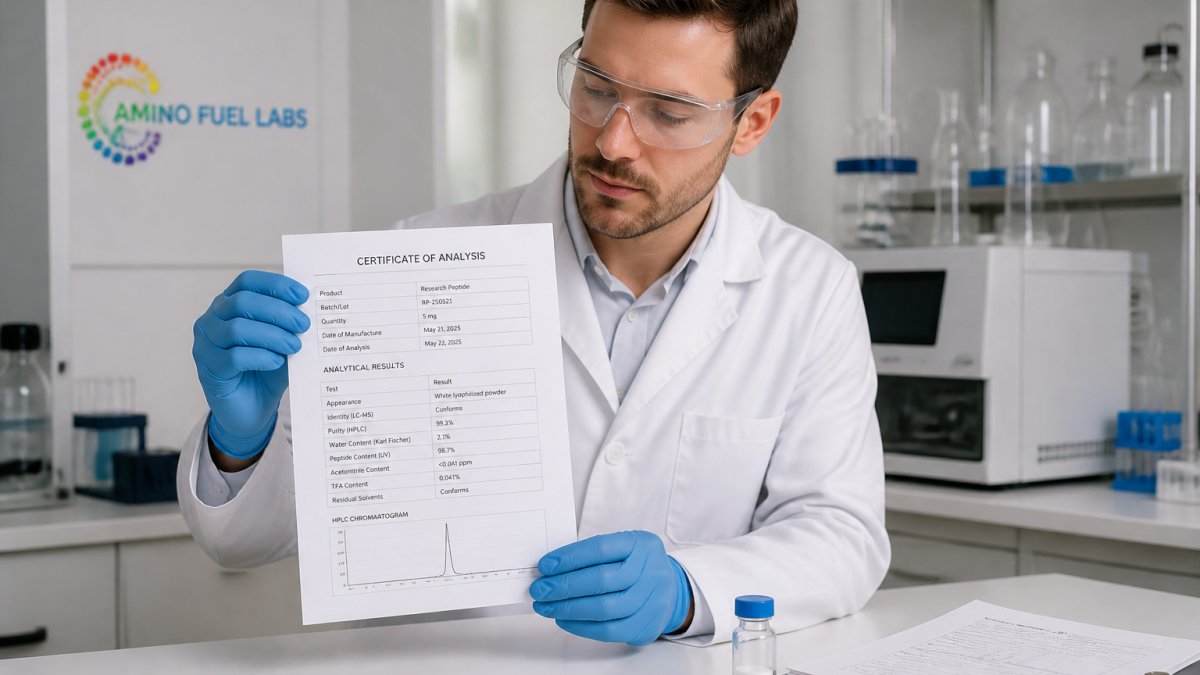
Read the COA in this order.
First, the lot number. Match it to the vial label. If the COA says "representative lot" or has no number, stop there.
Second, the analytical method. HPLC purity results should specify the column, detection wavelength, and gradient.
Third, the mass. Mass spectrometry confirms you received the peptide you ordered.
Fourth, the lab. An in-house COA is not the same as an independent one. Ask who ran the analysis.
Third-Party Tested Research Peptides: Separating Proof From Marketing
Third-party tested research peptides are compounds analyzed by a laboratory independent of the supplier. The phrase is easy to print; verifying it is the work.
A supplier with genuine third-party testing will answer without hesitation, and will explain the difference between research-grade and pharmaceutical-grade material, since the distinction affects what testing is appropriate.
A second layer separates serious vendors: how they handle moisture and salt content.
For background on how independent analytical testing is generally structured, the FDA guidance on analytical procedures and methods validation is a useful reference point for what good documentation looks like.
Pricing, Shipping, and Payment for Small Orders
Pricing for small orders depends on quantity, compound, documentation level, and delivery speed, so a single published price rarely tells you much. Compare structure instead, and normalize quotes so the cheapest-looking option is not the most expensive per usable milligram.
Normalize Every Quote to a Common Unit
Ask each supplier to quote in the same unit. The most useful is price per milligram of peptide content, not price per vial, which hides fill mass, peptide content by mass, and whether documentation is included.
| Factor | What to Ask | Why It Matters |
|---|---|---|
| Unit pricing | Is the price per vial, per mg, or per gram? | Per-mg pricing makes cross-supplier comparison possible |
| Fill vs. content | Is the stated mass fill mass or peptide content? | Salt and moisture content change the usable amount |
| Order minimums | Is there a dollar minimum per order? | A low MOQ with a high order minimum defeats the purpose |
| Documentation fee | Is the COA included or an add-on? | Charging extra for a COA signals a documentation gap |
| Custom synthesis fee | Is there a separate setup or synthesis fee? | Small custom runs often carry a fixed fee |
| Shipping cost | Flat rate, weight-based, or free above a threshold? | Small orders can be dominated by shipping cost |
| Payment options | Card, ACH, wire, or purchase order? | Limited options can slow institutional purchasing |
| Delivery window | What is the typical order-to-door time? | Timeline risk kills pilot studies |
Shipping Models and What They Mean for Your Timeline
There are three shipping models in this market, and they produce very different delivery windows:
- Domestic stocked inventory: the supplier holds lots in a domestic facility and ships on a short window. Fastest, but the catalog is limited to what is stocked.
- Domestic synthesis on demand: the supplier synthesizes in a domestic facility after you order. Slower than stocked inventory, but supports custom sequences at small scale.
- Overseas synthesis and import: the order is synthesized abroad and routed through customs. The longest and least predictable window, and the one most likely to change your study timeline.
Ask which model applies to the compound you are ordering, because a supplier can use different models for different products. "Fast fulfillment" on the homepage does not tell you which model your vial will follow.
Payment Workflows for Institutional Buyers
Institutional purchasing often needs a purchase order and an invoice, not a card checkout. Confirm before you commit that the supplier can:
- Accept a purchase order and issue a net-terms invoice
- Provide a W-9 or equivalent tax documentation on request
- Ship to an institutional receiving address with your department's required paperwork
A card-only supplier can work for a small pilot but will slow a departmental purchase. Ask early.
A Simple Quote-Request Template
Send the same five-line request to every supplier so responses are comparable:
- Compound, sequence, and quantity in mg
- Whether the quoted mass is fill mass or peptide content
- Whether a lot-matched COA is included at no extra charge
- Shipping model, cost, and typical order-to-door window
- Accepted payment methods and whether purchase orders are supported
For guidance on how research materials should be handled and documented in a laboratory setting, the NIH Office of Research Integrity resources covers record-keeping expectations that apply to your own study files.
Red Flags and Research-Use Compliance
Red flags in this market are consistent and easy to spot:
- No lot number on the vial or the COA. Traceability starts at the label.
- Purity claims with no method. "99% pure" without HPLC details is a slogan.
- No mass spectrometry data. Purity without identity confirmation proves little.
On compliance: research peptides are sold for laboratory research use only, and that label is not decorative. The FTC guidance on health claims explains why unsubstantiated therapeutic claims draw regulatory attention, and the same scrutiny can reach the researcher who sourced the material.
We recommend keeping a simple file for every order: the COA, the lot number, the order confirmation, and the storage record. If your institution ever audits your sourcing, that file is your defense.
Conclusion
The hardest part of sourcing small quantities is not finding a supplier who will sell you a vial. It is finding one who documents it properly and still ships quickly.
Amino Fuel Labs was built around that gap.
Get started with Amino Fuel Labs and run your next small-quantity order with documentation you can hand to your institution without a second thought.
Frequently Asked Questions
Can I order research peptides in small quantities without a bulk commitment?
Many small quantity peptide suppliers will sell single vials or low-unit orders, but minimum order quantity varies widely, so ask before you assume. Confirm three things in writing: the smallest sellable unit, whether a sample or pilot order is available, and whether custom sequence requests carry a separate minimum. Amino Fuel Labs works with researchers running small-batch, exploratory studies rather than requiring bulk supply commitments. Get the MOQ confirmed in your quote request so your protocol budget is not derailed after you have already planned the assay.
What documentation should a research peptide supplier provide with each lot?
Ask for a lot-matched Certificate of Analysis, not a generic sample COA. It should show the peptide name and sequence, lot number, purity from HPLC, the analytical method used, and the testing lab's identity. Mass spectrometry confirmation and moisture or salt content matter too, because a purity percentage alone does not tell you actual peptide content. Third-party tested research peptides come with reports traceable to an independent lab. If a supplier cannot match the COA lot number to the vial you receive, treat that as a documentation gap and request clarification before ordering.
How do I find a legitimate research peptide supplier for a small lab?
Start with documentation, not price. Request a sample COA and check that the lot number matches a real product, that the testing lab is named, and that HPLC and MS data are both present. Then confirm the minimum order quantity, shipping origin and turnaround, and payment terms. Ask how the supplier handles a failed purity specification. A vendor that answers these questions in specifics, and lets you audit its lot-matching process, is a stronger signal than a low headline price. Verify research-use-only labeling before you buy.
How can I compare peptide purity and batch documentation across suppliers?
Put the numbers side by side on the same basis. Ask each supplier for the HPLC purity figure, whether it accounts for moisture and salt content, the method used, and the testing lab. Compare minimum order quantities and what a small order actually costs per unit, including shipping. Then check batch documentation: is the COA lot-specific, dated, and signed by an independent lab? A consistent checklist applied to every vendor beats reading marketing claims. Request current documentation for the exact lot you will receive rather than a historical sample.
