
Last Updated: October 31, 2026
Quick Summary
A reliable peptide supplier offers lot-matched third-party certificates of analysis with accessible HPLC and MS lab reports, so you can match the certificate lot number to your vial. Verify the named lab, method disclosure, and test date before ordering.
- Compare the COA lot number character by character against the vial label before use.
- A purity percentage without a chromatogram, column, or method is unverifiable.
- HPLC establishes relative purity while mass spectrometry confirms peptide identity.
- Request the COA for the specific lot you will receive, not a prior order.
- Score suppliers on lot-matched COAs and independent labs before comparing price.
Table of Contents
- Why Lot-Matched Documentation Separates Reliable Peptide Suppliers From the Rest
- Peptide Supplier COA: What a Complete Certificate of Analysis Should Contain
- How to Verify Peptide COA Documents Step by Step
- Research Peptide Purity Testing: HPLC, Mass Spectrometry, and What the Numbers Actually Prove
- Peptide Supplier Quality Control: Batch Consistency, Manufacturing Standards, and Traceability
- Independent Testing Methodology: How to Tell Third-Party Labs From In-House Claims
- A Transparent Comparison Framework for Ranking Peptide Vendors
- Requesting a Lot-Matched COA From Amino Fuel Labs Before Your Next Study
- Frequently Asked Questions
Why Lot-Matched Documentation Separates Reliable Peptide Suppliers From the Rest
Ask a peptide supplier for a certificate of analysis and most will send one within a day. That gap, between a document existing and a document actually describing your material, is where supplier quality gets decided. (Source: FDA guidance on analytical procedures and methods validation)
A COA that cannot be traced to a specific lot proves nothing about the powder in your freezer.
Below are nine checks that separate suppliers who can back up a purity claim from those who simply repeat one, each runnable before you order.
Peptide Supplier COA: What a Complete Certificate of Analysis Should Contain
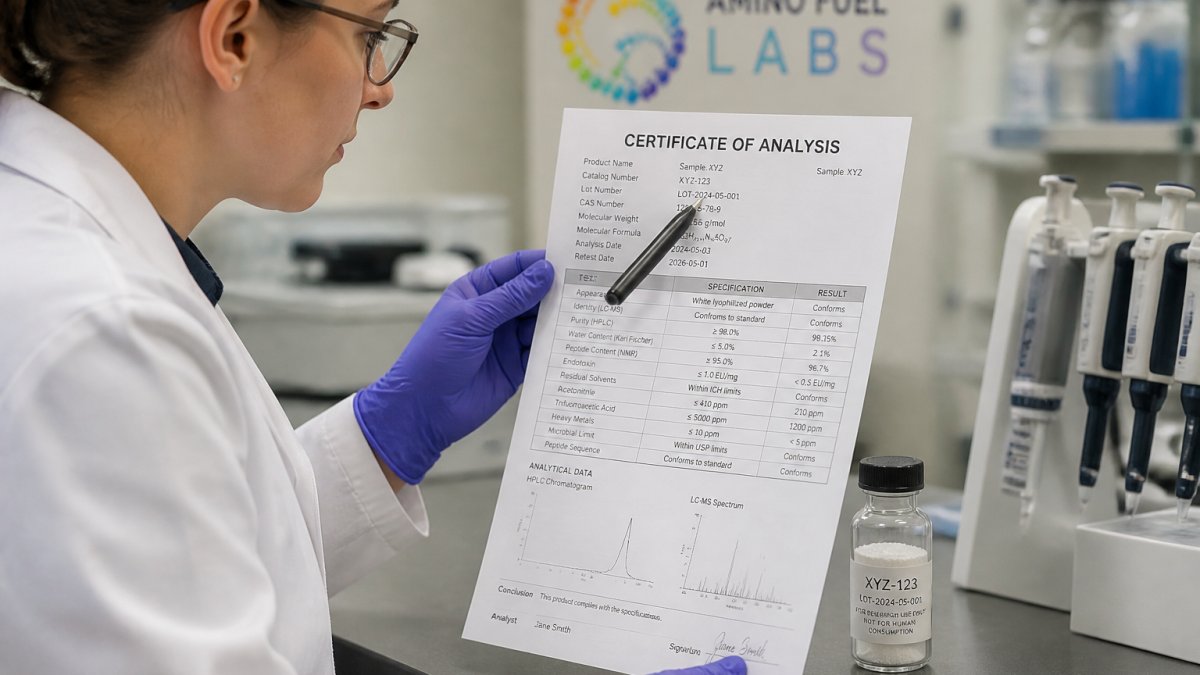
A complete peptide supplier COA identifies the material, the lot, the test methods, and the results in enough detail that an independent reviewer could reconstruct what was measured. Anything less is a marketing document.
The FDA guidance on analytical procedures and methods validation frames the underlying principle: a result means little without the method that produced it. For research peptides, that means the certificate should name the analytical technique, not just report a number.
Fields That Must Match Between the COA and Your Vial
The check most researchers skip is the simplest one. Lay the certificate beside the vial and compare, field by field:
- <input disabled type="checkbox"> Lot number appears identically on both, including any suffix or leading zeros
- <input disabled type="checkbox"> Peptide name and sequence match the label exactly, including any salt form (acetate vs. trifluoroacetate)
- <input disabled type="checkbox"> Molecular weight is stated and consistent with the sequence and salt form
If any line fails, stop. A mismatched lot number means the document describes a different batch than the one you are about to use.
What Separates a Real COA From a Reproduced One
Most supplier COAs share the same skeleton, so the differentiator is internal consistency. Three checks expose a document that was assembled rather than issued:
- Method-result coherence. A 98.5% HPLC purity figure should come with a chromatogram showing a main peak at the expected retention time and a stated integration method. A percentage with no chromatogram, column, mobile phase, or detection wavelength is a conclusion without evidence.
- Identity confirmation. Mass spectrometry results should list the observed mass-to-charge ratio alongside the theoretical mass for the stated sequence. For a deeper look at how mass spectrometry confirms peptide identity, see mass spectrometry for peptide identity confirmation. "MS: conforms" with no numbers is unverifiable.
- Document versioning. Legitimate certificates carry a report number, an issue date, and often a revision marker. Without a document identifier, a COA cannot be tied to a test event or audited later.
Suppliers without lot-matched records sometimes reuse a single generic COA across catalog items or production runs. The tell: a test date predating the lot's manufacture date, or a document listing a peptide name but no sequence.
Reconciling the COA to the Physical Vial
Matching fields is necessary but not sufficient. The stronger check is whether the document and the physical product tell the same story:
- Label-to-certificate lot match. The vial label's lot number should appear on the certificate with no transcription differences. Photograph both and compare side by side if the label is small.
- Fill and presentation consistency. A certificate reporting a 5 mg fill should match a 5 mg vial label. Fill discrepancies often signal a certificate copied from a different SKU.
- Storage statement alignment. The certificate's storage conditions should match your shipping and handling documentation. A certificate saying -20°C paired with a room-temperature shipping insert is a contradiction worth raising before use.
For a fuller walkthrough of each step, our guide on how to verify peptide purity covers the sequence in more depth.
How to Verify Peptide COA Documents Step by Step
Verification takes about fifteen minutes per lot and follows a fixed sequence, since each step assumes the previous one passed.
- Confirm the lot number matches. Compare the certificate to the vial label character by character.
- Identify the testing laboratory. Search the lab name independently; a real analytical lab has a website, physical address, and testing scope.
- Check the method against the result. HPLC for purity, mass spectrometry for identity. A purity figure with no stated method is unverifiable.
- Read the chromatogram, not just the percentage. Look at the main peak, its retention time, and impurity distribution.
- Confirm the test date precedes the release date. Testing after release defeats the purpose.
- Request the raw data if anything looks off. A confident supplier will share the underlying report.
For a fuller walkthrough of each step, our guide on how to verify peptide purity covers the sequence in more depth.
Research Peptide Purity Testing: HPLC, Mass Spectrometry, and What the Numbers Actually Prove
Research peptide purity testing answers two separate questions, and conflating them is the most common mistake we see. HPLC tells you how much of the material is the target peptide; mass spectrometry tells you whether it is the right peptide at all.
High-performance liquid chromatography separates components and reports the main peak area as a percentage of total peak area, relative composition of what was detected, not absolute peptide content.
Mass spectrometry ionizes the sample and measures mass-to-charge ratios, confirming molecular identity against the expected mass.
Our explainer on HPLC and mass spectrometry in peptide identity and purity testing breaks down how each method answers a different analytical question.
Why a Purity Percentage Alone Can Mislead You
A purity percentage is a ratio, not a quantity. A sample 98% pure by HPLC can still contain less actual peptide than the label implies once moisture, counterions, and residual salts are accounted for.
That is why we report both the purity figure and the method behind it, and why researchers should read the chromatogram rather than the headline number.
Peptide Supplier Quality Control: Batch Consistency, Manufacturing Standards, and Traceability
Peptide supplier quality control is the set of production and documentation controls that keep one lot behaving like the next.
Traceability is the backbone of that system. Our guide to peptide supplier lot traceability requirements sets out what that trail should include.
Manufacturing standards matter too: production controls, purification methods, and handling procedures determine whether a supplier can reproduce a result months later.
Independent Testing Methodology: How to Tell Third-Party Labs From In-House Claims
The phrase "third-party tested" gets used loosely. The test is whether the laboratory that produced the result is genuinely separate from the seller, and whether you can verify that separation.
Three signals distinguish real independent testing:
- The lab is named on the certificate, with contact details you can check independently
- The lab's report exists as its own document, not a paragraph inside a seller's brochure
- The lab's methods and equipment match the analysis being claimed
In-house testing is not automatically invalid, but it carries less weight because the seller controls both the sample and the result. Our page on research grade peptides with verified third-party COAs shows what genuine documentation looks like.
What Independent Labs Actually Test, and What Each Method Can Establish
A third-party report is only as useful as the methods behind it. Two techniques carry most of the weight in peptide analysis, and they answer different questions:
High-performance liquid chromatography (HPLC) separates components and reports the main peak area as a percentage of total detected peak area. It establishes relative purity, how much of the UV-absorbing material is the target peak, but not identity, moisture, residual salts, or counterion content.
Mass spectrometry (MS), typically electrospray ionization (ESI) or matrix-assisted laser desorption/ionization (MALDI), measures mass-to-charge ratios and confirms the dominant species matches the expected molecular mass for the stated sequence.
A complete independent report therefore pairs the two: HPLC for purity, MS for identity, with theoretical and observed masses both stated. Reports listing only one method leave half the question unanswered.
Reading the Lab Report, Not Just the Headline Number
When you receive a third-party report, the useful information is in the details:
- Chromatogram quality. Look for a single dominant peak with a retention time consistent with the method's gradient. A broad or split main peak suggests degradation or a mixture, even at a high reported percentage.
- Integration parameters. The report should state how peak area was integrated (baseline method, threshold). Manual integration that excludes small peaks is not comparable to a standard method.
- Mass accuracy. The observed mass should fall within a stated tolerance of the theoretical mass (commonly ppm or Da). A mass with no tolerance is harder to evaluate.
In-House Versus Independent: What the Distinction Actually Buys You
In-house testing can be technically sound, but it concentrates control of the sample, method, and reported result in the party with a commercial interest in the outcome.
The practical test is not whether a supplier claims third-party testing but whether you can trace a specific lot to a specific report from a specific lab.
Suppliers with mature documentation systems keep the lab report and the COA as separate documents that reference each other by number.
A Transparent Comparison Framework for Ranking Peptide Vendors
Ranking peptide vendors on price alone tells you little about what arrives in the box. A transparent framework scores suppliers on documentation you can inspect, weighted toward the checks that are hardest to fake.
| Criterion | What to Look For | Why It Matters |
|---|---|---|
| Lot-matched COA | Certificate lot number matches vial | Proves the document describes your material |
| Independent lab | Named, verifiable third party | Removes seller control over results |
| Method disclosure | HPLC and MS both reported | Confirms purity and identity separately |
| Documentation recency | Test date close to release | Reflects the batch you received |
| Traceability | Full production record available | Supports batch consistency |
| Catalog breadth | Compounds stocked, not backordered | Keeps studies on schedule |
| Handling controls | Storage and shipping documentation | Protects material in transit |
Score each supplier against these criteria before comparing anything else. A vendor that fails the first three rows cannot be rescued by a lower price.
Requesting a Lot-Matched COA From Amino Fuel Labs Before Your Next Study
Documentation you cannot inspect before purchase is documentation you are trusting on faith. We would rather you verify first.
Our products are offered with lot-matched third-party certificates of analysis and accessible HPLC and MS lab reports, so you can run the checks above against the actual batch.
If your institution needs to ask about our lot-matching system or third-party lab relationships, contact our team.
Frequently Asked Questions
What should a research peptide Certificate of Analysis include?
A complete COA should list the peptide name and sequence, the lot number, the testing date, and the analytical methods used, typically HPLC for purity and mass spectrometry for identity. It should show the purity percentage with the chromatogram, the measured molecular weight against the theoretical value, and the name of the testing laboratory. Any COA missing the lot number or the testing date cannot be tied to a specific batch, which makes it far less useful for verification.
How can you verify that a COA matches a peptide product lot?
Start by comparing the lot number printed on the vial label with the lot number on the COA, character for character. Check that the peptide name, quantity, and testing date line up as well. Then confirm the document came from the supplier directly, not a forwarded copy, and that the third-party lab named on it is a real, contactable facility. A peptide supplier that cannot produce a lot-matched document on request is a warning sign worth taking seriously.
Is a third-party COA enough to verify peptide quality?
A third-party COA is a strong starting point, but it is not a complete guarantee. Check the testing methodology, the purity threshold reported, and how recent the test is, since a COA from an old batch tells you little about what ships today. Also confirm the document is lot-specific rather than a generic sample report reused across products. Pairing the COA with questions about peptide supplier quality control practices gives you a fuller picture.
What questions should researchers ask a peptide supplier before ordering?
Ask which independent laboratory performs the testing and whether you can see its name on the COA. Ask whether every lot is tested or only periodic samples, and how quickly documentation is provided after a batch is produced. Confirm the purity method used, whether HPLC accounts for moisture and salt content, and what the supplier's policy is if a lot fails specification. Finally, ask about storage and shipping conditions, since handling after production affects product consistency.
The real test of a peptide supplier is not what its purity claim says, but whether the paperwork behind that claim survives a fifteen-minute check. Amino Fuel Labs builds every order around lot-matched third-party COAs, accessible HPLC and MS reports, and 99%+ HPLC purity, so the verification work is possible before your study begins. Get started with Amino Fuel Labs and confirm the documentation on your next lot before it ships.
